| Mk4 has been announced, and we need to talk about what it means for the future of this website.
Please join the discussion either on the WMU Facebook Group or the Talk:Main Page area of this wiki.
|
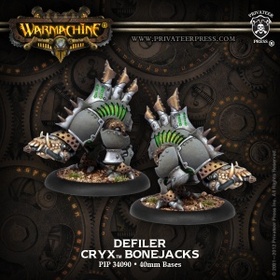
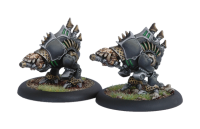
Unlike the Deathripper, the Defiler avoids close combat. Instead it fires on the enemy from a distance with its sludge cannon, which spews concentrated, caustic poison that consumes metal and stone more easily than flame eats wood. Faced with the potential of its arc node and the horrendous wounds caused by its sludge cannon, enemies often desperately try to close and deal with this bonejack before their allies are torn apart.
|
|

|
When you go to physically buy Defilers, you get a box with 2 models. Despite this, they are added to your army one model at a time.
|
|
Basic Info
| Defiler |
| Missing Info |
|
|
| COST |
{{{cacost}}} |
| UNIT SIZE |
{{{casize}}} |
| FA |
{{{cafa}}} |
| Warcaster 0 |
| BASE |
Medium |
| SPD |
7 |
| STR |
7 |
| MAT |
5 |
| RAT |
5 |
| M.A. |
N/A |
| DEF |
14 |
| ARM |
14 |
| CMD |
N/A |
| ESSENCE |
{{{essence}}} |
| FOCUS |
N/A |
| FURY |
N/A |
| THRS |
N/A |
| HP |
20 |
| F. Field |
N/A |
|
|
|
|
| WJP |
{{{wjp}}} |
| WBP |
{{{wbp}}} |
| IHP |
{{{ihp}}} |
| FA |
U |
| UNIT SIZE |
N/A |
| COST |
7 |
| N/A |
| N/A |
|
|
|
|
| N/A |
| Warcaster 1 |
| COST |
N/A |
| N/A |
Understanding
the Statblock |
|
Warjack - All warjacks share the same set of special rules. Most notably being big and stompy. Click here for a newbie-friendly recap, or click here for the full rules.
Abilities
Weapons
|
|
|
|
|
|
|
|
|
|
|
|
|
|
|
|
|
| Sludge Cannon
|

|
|
RNG
|
ROF
|
AOE
|
POW
|
LOCATION
|
|
|
|
SP8
|
1
|
-
|
10
|
Head
|
|
|
|
|
|
|
|
|
|
|
|
|
|
|
|
|
|
|
|
|
| Bash
|

|
|
RNG
|
POW
|
P+S
|
LOCATION
|
|
|
|
0.5
|
0
|
7
|
-
|
|
|
|
Theme Forces
Recent Changes
No changes since 2021.10
Thoughts on Defiler
Defiler in a nutshell
Defiler as an arc node
The Arc Node is one of the most useful abilities a model can have, and with Cryx you can field them very cheaply. An arc node allows your warcaster to cast spells using the arc node as the point of origin. The obvious benefit is casting spells on the frontline while staying safely in the backline. You can also use it to launch surprise attacks from unexpected angles, by running an arc node right across the board into a good position before activating your warcaster. For this reason it pays to keep at least one arc node on the outskirts of the conflict, waiting for an opportunity.
Defiler as a combat jack
The Sludge Cannon is a good weapon for hosing down a unit of infantry, but due to the poor RAT will mostly miss. Luckily, sprays ignore a lot of defensive bonus and as such, can be considered to be more precise than raw stats would indicate. In any case sprays are a very useful tool for eliminating key targets, and the extra speed the bonejack brings can make it appealing in certain situations, especially if you ran on the first turn.
Combos & Synergies
- Seek casters who can increase a Defiler's RAT or reduce an enemies defense.
- Take one under Aiakos2 and on feat turn it can charge 13" and spray 8" (total 21" threat).
- Skarre2 or Rahera both have black spot which is useful for hitting and the nature of a spray make the second shot more likely. The former grants Future Sight for efficiency the latter has Rough Seas to help deliver the Jack.
Drawbacks & Downsides
- Its damage grid has just enough boxes to allow the bonejack to take a good hit and keep going, but a second one will likely leave it crippled if not totally destroyed. This sets the tone for Cryx bonejacks being fast and hard to hit, but easily damaged if they are struck.
- The Defiler costs slightly more points than other arc nodes.
- Once engaged by an enemy the Defiler can't arc nor shoot. And it sucks at melee.
Tricks & Tips
- Slam a target to cause damage and leave it knocked down. This has the added benefit of leaving the Defiler out of combat afterwards so its arc node may still be used.
Other
Trivia
Other Cryx models
Rules Clarifications

|
Rules Clarification : Corrosion (Edit)
- If you deploy in corrosion hazard terrain (Acid Pool), then you get corroded before the game starts.
- Deploying a model in a hazard counts as being "put into play" in the hazard. Being put into play counts as "entering". When you enter a hazard, you trigger the hazard.
- A weapon can inflict continuous corrosion without itself being a corrosion damage weapon (for example, the Acidic Touch animus). In this case, the attack can hurt models with Immunity: Corrosion it just won't apply the continuous effect.
|
|
|
Rules Clarification : Warjack (Edit)
- The Cortex/Induction core rule means a warjack cannot have more than 3 focus at any time (maybe 4 if they're really special).
- Many abilities give out focus and don't state an upper limit (such as Convection and Empower). Despite not stating an upper limit, they are always "hard-limited" by the core rule.
- A warjack can have more than 3 focus during a turn, though. For instance, a knocked down warjack can Power Up and be Allocated 2 focus, then spend 1 to shake knockdown, then another model could Empower it back up to 3.
- Warjacks cannot spend focus outside of their activation. For instance, they can't boost free strikes or trigger Powerful Attack on Broadsides. (Infernal Ruling)
Inert warjacks
- Abilities that say they cannot be used if the model is stationary (such as Shield Guard) cannot be used while a warjack is inert, either. Refer "Warcaster Destruction", page 59 of the core rulebook.
|
Rules Clarification : Construct - None yet. (Edit)
|
|
Rules Clarification : Channeler and/or Arc Node (Edit)
General
- It is possible to channel a spell with a range of CTRL. The control range is still measured from the caster though, so channeling it has zero effect ... unless you've got something like Empowered Arc Node or Reaction Drive. Stuff like that can trigger. (Infernal Ruling)
Channeling in melee
- A channeler that is engaged by an enemy model can not channel.
- A channeler that is engaging an enemy model can channel. (For example, the channeler is standing in the enemy's back arc.)
Channeler - LOS
- You use the channeler's abilities when determining LOS (such as whether you can see your target through a forest).
- If the channeler has an ability to ignore LOS or DEF bonuses (such as Eyeless Sight), then you only apply that "ignorance" to LOS (but not to the DEF bonus).
Caster - Attack roll
- You use the caster's abilities when determining attack roll modifiers (such as whether a target standing in a forest gets +2 DEF or not).
- If the caster has an ability to ignore LOS or DEF bonuses (such as Eyeless Sight), then you only apply that "ignorance" to the dice roll (but not to the LOS).
Stealth - It affects both LOS and the attack roll
- Since Stealth has both a LOS modifier (stealth models more than 5" away aren't intervening models) and an attack roll modifier (stealth models more than 5" away are auto-missed) things get a little complicated.
- If only the channeler ignores stealth, then all stealth models count as intervening models and block LOS, but the caster will auto-miss models more than 5" from the channeler.
- If only the caster ignores stealth, then only models within 5" of the channeler block LOS, but the caster won't auto-miss no matter what you target.
- If both channeler and caster ignore Stealth, it works as you'd expect.
-
Stealth Examples [Show/Hide]
- Caster has Eyeless Sight, channeler does not.
- Stealth model is within 5" of channeler
- LOS - The model counts as an intervening model, as per the normal Stealth rules
- Attack roll - If you attack it then you don't auto-miss, as per the normal Stealth rules
- Stealth model is more than 5" away from channeler
- LOS - The model does not count as an intervening model, as per the normal Stealth rules.
- Attack roll - If you attack it then you don't auto-miss, as the attacking model has Eyeless Sight.
- Stealth model is more than 5" away from channeler, and you want to target a model behind it.
- LOS - The front model doesn't block LOS
- Attack roll - Doesn't auto-miss
-
- Caster hasn't got Eyeless Sight, channeler does.
- Stealth model is within 5" of channeler
- LOS - The model counts as an intervening model, as per the normal Stealth rules
- Attack roll - If you attack it then you don't auto-miss, as per the normal Stealth rules
- Stealth model is more than 5" away from channeler
- LOS - The model counts as an intervening model, because the model drawing LOS ignores Stealth.
- Attack roll - If you attack it then you will auto-miss, as the attacker doesn't ignore Stealth.
- Stealth model is more than 5" away from channeler, and you want to target a model behind it.
- LOS - The front model blocks LOS, so you can't target the rear model.
- Attack roll - N/A
|