| Mk4 has been announced, and we need to talk about what it means for the future of this website.
Please join the discussion either on the WMU Facebook Group or the Talk:Main Page area of this wiki.
|
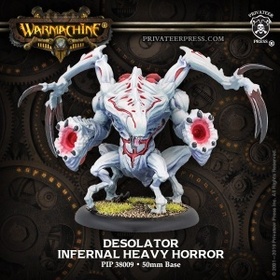
The larger horrors sent forth by the infernals are massive hulks, their strange hides resistant to cutting and resilient against all but the mightiest blows. Desolators are terrifying to behold, their bodies festooned with myriad tumor-like bulbous sacs, each serving as a bladder for caustic liquids this horror unleashes through the maws of its attack limbs to obliterate its foes. Enemies closing with a Desolator are soon shredded by its upper limbs, which end in exceedingly sharp long-bladed claws.
Basic Info
| Desolator |
| Missing Info |
|
|
| COST |
{{{cacost}}} |
| UNIT SIZE |
{{{casize}}} |
| FA |
{{{cafa}}} |
| Warcaster 0 |
| BASE |
Large |
| SPD |
5 |
| STR |
11 |
| MAT |
6 |
| RAT |
6 |
| M.A. |
N/A |
| DEF |
11 |
| ARM |
18 |
| CMD |
N/A |
| ESSENCE |
4 |
| FOCUS |
N/A |
| FURY |
N/A |
| THRS |
N/A |
| HP |
24 |
| F. Field |
N/A |
|
|
|
|
| WJP |
{{{wjp}}} |
| WBP |
{{{wbp}}} |
| IHP |
{{{ihp}}} |
| FA |
U |
| UNIT SIZE |
N/A |
| COST |
14 |
| N/A |
| N/A |
|
|
|
|
| N/A |
| Warcaster 1 |
| COST |
N/A |
| N/A |
Understanding
the Statblock |
|
Horror - This model is the Infernal equivalent of a warjack or warbeast. They have a number of unique rules (which you can read here), but fulfil the same role; namely, being big and stompy.
Abilities
Weapons
|
|
|
|
|
|
|
|
|
|
|
|
|
|
|
|
| Black Bile (x2)
|

|
|
RNG
|
ROF
|
AOE
|
POW
|
|
|
|
SP 8
|
1
|
-
|
10 (★)
|
|
|
(★) This weapon is effectively POW 12 thanks to Withering Death
|
|
|
|
|
|
|
|
|
|
|
|
|
|
|
|
|
| Claw (x2)
|

|
|
RNG
|
POW
|
P+S
|
|
|
|
1
|
3
|
14
|
|
|
|
Theme Forces
Recent Changes
2021.10 Mega Update
Thoughts on the Desolator
Desolator in a Nutshell
The Desolator & the Tormentor are both Quevash, with the Desolator trading out it's big crab hands for a pair of useful sprays (and some claws!). The sprays reduce enemy armor on hit, so the Desolator is a key piece for increasing the damage of your army. Assault helps it put the sprays where it is needed.
When to Summon
Summon when you need the cloud to block LoS or to limit 1 wound models from moving through a specific spot. With ancillary attack you can have one provide an armor debuff the turn it is summoned.
Combos & Synergies
Wretches can use Ancillary Attack on them the turn they are summoned to provide an armor debuff or clear out a group of models.
Each of the infernal masters appreciates being able to lower armor on demand and each can combine it with their own effects to increase damage (Scything Touch, Curse of Shadows, or Synergy)
Drawbacks & Downsides
Withering death only lasts for 1 turn.
- vs anything with corrosion immunity it’s very pillow fisted for its cost and durability. Crucible Guard especially serve as a bad match up.
Tricks & Tips
- The ARM debuff from Withering Death is applied before the damage roll, making it effectively POW 12 sprays.
Other
Trivia
- Released with the Faction launch (2019.06)
- In the IKRPG this Horror and the Tormentor were known as a "Quevash".
Other Infernal models
Rules Clarifications

|
Rules Clarification : Horror (Edit)
- Horrors cannot spend essence outside of their activation. For instance, they can't boost free strikes. (Infernal Ruling)
- If both the master and the horror are damaged by the same attack (such as an AOE), then you need to apply the 'normal' damage to the horror before the transferred damage. This distinction can be important when you're working out who/what actually destroyed the horror. (Infernal Ruling)
- Tithe is optional (despite the use of the word "must" in the Tithe rules; it's used in much the same way as "a warjack must spend 1 focus to run"). (Infernal Ruling)
|
|
|
Rules Clarification: : Assault (Edit)
(Click Expand to read)
|
General
Step 1: Declare the charge
- Are you in already melee? With any enemy, not just your charge target?
- If yes, you don't get an Assault attack at all (Refer to the latest Errata). Instead it's just a normal charge.
- If no, continue to Step 2.
- Note: You cannot be "in melee" with a stationary/knocked down target. Feel free to declare charges (and Assault shots) in this case.
- You can even charge a knocked down model you're in B2B with, advance 0", and get your ranged attack and your melee attack(s).
Step 2: Move the charging model
- As soon as the movement is finished, determine whether it was a successful charge or not.
- Do this before resolving anything that triggers on "Ends Movement" (like Admonition, Countercharge).
- Do this before resolving your Assault attack.
- Did you make a successful charge? You get the ranged attack even though you're "in melee" (not yet though).
- Did you fail the charge? You will get the Assault shot anyway (not yet though).
- Did you fail the charge, but end your movement in melee with someone different to your charge target? You get the ranged attack even though you're "in melee" (not yet though). (Infernal Ruling)
- Now that you've figured out whether the charge successful, you resolve "Ends Movement" effects (such as Countercharge) before the Assault attack. (Infernal Ruling).
- If something happens at this point that changes whether a model is in/out of melee range, it does not retroactively change a failed charge into a successful charge or vice versa.
- If your charge was successful you may use "any time" abilities between 'finishing movement' and 'starting Assault attack'. (Infernal Ruling)
- If you fail your charge, you may not use "any time" abilities before or after making the Assault attack. (Infernal Ruling)

|
Tip !
Assault is not a "triggered ability" and it will never trigger simultaneously with another ability that triggers/resolves at "ends movement". Instead, the other ability is always resolved before the Assault shot.
You can make an Assault shot even if you charged less than 3".
|
Step 3: Make the ranged attack
- The ranged attack is optional.
- Since the Assault attack is outside your Combat Action, you can only do a basic ranged attack. CRA & Special ranged attacks are only allowed during your Combat Action, you can't do them. (Infernal Ruling CRA & Special Attack)
- Did you move at least 3" during the charge movement? Who cares, that is irrelevant to the Assault attack!
- Make your ranged attack vs your charge target
- If the charge target is already dead (which can happen when units charge) then you don't get to redirect your Assault attack vs 'someone else'. You simply don't get an Assault attack. (Infernal Ruling)
- A model which can do something "instead of making a ranged attack" (such as the Spriggan's Targeting Flare) then they can do that as an Assault attack. (Infernal Ruling)
- If your ranged attacks triggers other attacks/damage that occur "after the attack" (such as Drag or Electro Leap) then those will resolve as per normal, regardless of whether you had a successful charge or not. (Infernal Ruling)
- Is the target in melee with the shooter?
- If yes, then you ignore the +4 DEF bonus (as per the 3rd paragraph of "Targeting a Model in Melee" (TMM) rules)
- If no, resolve the ranged attack exactly the same as if it were a normal ranged attack.
Step 4: After finishing the Assault attack
- If it was an unsuccessful charge, your activation now ends.
- If it was a successful charge, and your charge target is ...
- still alive, then you get your charge attack (as per the charge rules)
- dead, then you get your initial melee attack(s) vs anyone still in your melee range (as per the charge rules).
- Either way, you don't get to make more ranged attacks (other than the obvious exceptions like Gunfighter, of course).
Units
- Move all models in the unit before making any Assault attacks. (Infernal Ruling)
- Make all Assault attacks before making any Charge attacks. (Infernal Ruling)
- Each model in the unit is effectively "stalled" while you move/shoot the other models. This "stall" does not create an opportunity to use "any time" abilities. (Infernal Ruling)
- If a trooper's target dies before they make their Assault shot, they don't get to redirect it. You just skip their Assault shot. (Infernal Ruling)
- You cannot make Assault attacks while out of formation, as per the regular formation rules about making attacks.
- Assault & CRA (Edit)
- You cannot mix Combined Range Attacks with Assault shots, as CRA works during your combat action and Assault shots occur before it. (Infernal Ruling)
Other
- Warbeasts
- Warbeasts cannot use Assault during a Frenzy. Refer to the latest errata.
- Assault vs Countercharge ( Edit )
- Assault & Drag ( Edit )
- You determine whether a charge was successful or not before making the Assault attack.
- If you make an unsuccessful charge but then use Drag to get your charge target into melee range, then:
- It is still a failed charge and your activation is going to end after the Assault attack is resolved. (Infernal Ruling)
- You will get the free melee attack from Drag as part of resolving the Assault ranged attack. (Infernal Ruling)
- Whether or not your charge was successful, this free melee attack is not a charge attack. (Infernal Ruling)
- You won't be able to purchase additionals (because your activation ended).
|
|
|
Rules Clarification : Eyeless Sight (Edit)
- A model that ignores Stealth must ignore both aspects: both (1) the auto-missing, and (2) the 'not counting as an intervening model' parts.
- This can have some strange interactions with casters & channelers, if one has Eyeless Sight and one does not. There are examples on the Category:Channeler page.
- Blind vs Eyeless Sight (Edit)
- If a model is Blinded, and then given Eyeless Sight, then that model ignores Blind ... but it is technically still Blinded. So if you somehow later lose Eyeless Sight (for instance walking out of the range of Menoth's Sight), it will immediately go back to suffering the effects of Blind. (Infernal Ruling)
- Also this means stuff that only works vs Blind models (ie Hidden Blade) will still trigger vs a "Was Blinded but then got Eyeless" model.
- Anti-Cloud abilities vs Burning Earth (Edit)
- If you make a piece of terrain "Burning Earth" it counts as a cloud effect in addition to it's original type. This has 2 odd rulings:
- If any part of the terrain piece is "hit" by an ability that makes clouds expire (such as Gale Winds) then the entire terrain piece is taken off the table. (Infernal Ruling)
- If a model can ignore clouds but not the original terrain type, they don't ignore the terrain. For instance if you have a burning forest, then Eyeless Sight can't see through the forest. (Infernal Ruling)
|
|
|
Rules Clarification : Corrosion (Edit)
- If you deploy in corrosion hazard terrain (Acid Pool), then you get corroded before the game starts.
- Deploying a model in a hazard counts as being "put into play" in the hazard. Being put into play counts as "entering". When you enter a hazard, you trigger the hazard.
- A weapon can inflict continuous corrosion without itself being a corrosion damage weapon (for example, the Acidic Touch animus). In this case, the attack can hurt models with Immunity: Corrosion it just won't apply the continuous effect.
|
Rules Clarification : Soulless - None yet. (Edit)
|
|
Rules Clarification : Anathema (Edit)
-
Templates that do damage ( Edit) [Show/Hide]
- Most templates that do damage to models that walk into them are defined as "Hazards" (such as Burning Ground) but there are a few that aren't Hazards (such as Creeping Barrage and Wall of Fire). The differences are:
- A hazard is a terrain element
- Damage from a hazard template is never considered to be from the model or weapon/spell that put it into play. So hazards never gain special rules of the weapon/spell (such as a Damage Type or Poison), nor does it gain special rules of the model (such as Hand of Fate).
- Damage from a non-hazard template is considered to be from the model that put it in play. So non-hazards do get stuff like Hand of Fate. (Infernal Ruling)
- Damage from a hazard is not from an attack (so won't trigger stuff like Vengeance)
- Damage from a non-hazard is also not from an attack. Instead it will be a Special Action (Covering Fire), or a "instead of making an attack, place a template" (Creeping Barrage), or etc.
-
- Damage templates from spells is complicated:
- (Infernal Ruling)
- Spells that leave templates that are not hazards (such as Razor Wall) do Damage Type: Magical.
- Spells that leave templates that are hazards (such as Breath of Corruption) follow the rules for hazards, which are most likely not magical damage but it varies by the hazard.
- The initial damage when you place the template, if any, is Damage Type: Magical.
- For example, Breath of Corruption's initial POW 12 corrosion damage roll is Damage Type: Magical in addition to Damage Type: Corrosion. But the hazard that is put into play from Breath of Corruption is not Damage Type: Magical, just Damage Type: Corrosion.
-
- By default, when you put a template into play it doesn't do damage to models they overlap. The exceptions are templates that are created by an AOE weapon, and templates that explicitly say they do damage when they're placed.
- A model which is "placed" also counts as "entering" an area, so the template will damage any one who teleports/spawns into it, too.
- If two templates are overlapping, a model that enters them will take two points of damage.
|
|
|
Rules Clarification : Steady (Edit)
- If you are hit by a knockdown effect during your own turn then ... nothing happens. Unless it was a Slam or a Throw that knocked you down.
In that situation, there is a core rule that says "models immune to knockdown that become knocked down from a slam or throw must forfeit either movement or action when they activate". But that core rule doesn't apply to other knockdowns (lots of players assume it does)
- Steady models are still susceptible to other effects of knock-down attacks (if there are any). For instance, a Head Butt attack causes damage and knockdown - a Steady model would still take the damage.
- A knocked down model that gains Steady will remain knocked down, because the "cannot be knocked down" is not retroactively applied.
- Steady models who make a tough check during an advance can continue advancing. (Locked Thread)
|
|
|
Rules Clarification: : Magical Damage (Edit)
(Click Expand to read)
|
* The "Damage Type: Magical" is not inherited by "secondary" damage from a weapon. That is, stuff like arcs (Electro Leap) or hazards (Scather). (Infernal Ruling)
- All spells have "Damage Type: Magical" (refer errata).
- This is inherited by "immediate" secondary damage (such as Eruption of Spines). (Infernal Ruling)
- and might be inherited by "lingering" secondary damage (see below).
- If a spell leaves a template in play that does damage to models that walk around in it, then:
- if it is not described as a hazard it will do magical damage to models that walk around in it. (Example: Razor Wall)
- if it is a hazard then it will not do magical damage to models that walk around in it. Instead, it does whatever damage type is specified by the spell description. (Example: Breath of Corruption).
- (Infernal Ruling)
- If a weapon/spell includes Magic Damage and another kind of elemental damage it will still damage Incorporeal models. Incorporeal models are not affected by the rule "if an attack does multiple types of damage and a model is immune to at least one it is immune to the entire attack."
The phrase "immune to non-magical damage" should be interpreted as "immune to damage that doesn't include Damage Type: Magical" (not interpreted as "has immunity to Corrosion and Electricity and Cold and etc.")
|
Rules Clarification : Withering Death - None yet. (Edit)

 Assault
 Eyeless Sight
 Immunity: Corrosion
 Soulless


 Infernal Index (Edit)