101 - Charges
| 101 Articles (Edit) |
|---|
| Models
Gameplay
Attacks & Actions
Battlegroup Other |
| LPG Articles (Intermediate) |
| LOTS Articles (Advanced) |
- This article is part of Warmachine University's Crash Course (101) series, which is "Basic Training" aimed at new players who are still learning the core rules.
- The 101 series is intended to help you understand the rulebook, but you shouldn't be reading this instead of the rulebook.
Charges are a very important part of Warmachine gameplay. They let a model move faster and do more damage, but this bonus comes with restrictions.
General
- The charging model must have both its Normal Movement and its Combat Action available. (ie it hasn't forfeited one of them for some reason).
- The charging model must have LOS to it's charge target before it moves.
- Some model types have extra requirements if they want to charge:
- Troopers in a unit must receive an order, normally the Press Forward order.
- Warjacks and Monstrosities must spend one focus.
- Warbeasts must be forced for one fury.
- Horrors must spend one essence, if their outer ring is crippled.
Movement
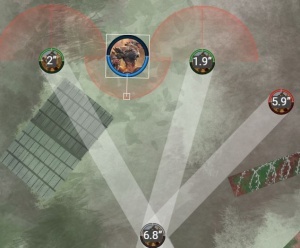
It can choose a direction that goes to either of the green positions, or anywhere in between those two positions.
It can choose the far left position as a charge angle, even though the building is going to block its movement. It will stop when it contacts the building, and have a failed charge.
It can not charge over to the red position, because that direction would never get it in melee with its charge target.
Bonus - The charging model gets +3" movement.
Restrictions
- You have to move in a straight line towards the target. You don't have to move directly towards your target - see diagram.
- The direction you pick has to get you in melee with the target. You can't just go haring off on a weird diagonal.
- You can't go past your charge target. More on that below.
- The direction you pick can be blocked such that you are forced to fail the charge. It just has to be "theoretically" possible to get in melee with the target along that line. Blocking yourself in can sometimes be tactically useful.
- Charges are blocked by obstacles (normal walks and runs can move over obstacles just fine). All movement is stopped by obstructions.
If you have something like Flight, Pathfinder, etc then obviously you can ignore certain types of terrain.
Result
If you finish your charge movement in melee range with your charge target, you have made a successful charge move. You must turn to directly face your charge target, then you can move on to Combat.
If they're not in your melee range, then your activation will immediately end.
- You cannot use an "At Any Time" ability if you fail a charge.
- The only thing you're allowed to do on a failed charge is resolve an Assault attack (if you have the Assault special rule at all). More about that in the Intermediate article LPG - Shooting while in melee.
Combat
Bonus
- If your charge movement is successful and more than 3", the damage roll for your first melee attack is automatically boosted (+d6 damage).
Null bonus
- If your charge movement is successful but less than 3", it is a successful charge move but it doesn't count as a charge attack.
- You don't get the +d6 damage
- You don't get any bonuses that directly reference "charge attacks" (such as Brutal Charge, Lance, Set Defence, etc).
- Cavalry models get really sad - more on that in a different lesson.
This "you made a successful charge but it doesn't count as a charge attack" normally only comes up for units that get the Press Forward order.
Other
- You can't spend focus/fury/etc to boost the damage again. But you can stack additional dice on to the damage roll (such as Weapon Master).
- If your first attack can damage multiple models (such as Thresher) then only the damage roll against your actual charge target is automatically boosted.
Already in melee
You absolutely can declare a charge even if you're already in melee. It's just more difficult to execute because:
- If you charge a model you are in melee with, you'll struggle to move 3" and get the charge bonus without breaking the "thou shall not pass" issue (described below).
- If you charge something else, the other model(s) already in melee will block most of your charge lane and/or get free strikes vs you.
With units, it's quite common to start the unit's activation with some troopers in melee and some outside. You give the charge order, and the entire unit has to obey the charge rules when it comes to their movement. Notably:
- The ones already in melee can't freely "shuffle around" to make more space. They have to move in a single straight line, even if they only move 0.25".
- The ones already in melee have to turn to directly face their target, even if they moved 0".
Redirected Attack
Sometimes before you get a chance to make your charge attack, your charge target will be destroyed or move out of your melee range.
When this happens, you get a chance to redirect your attack:
- Your redirected attack is not a charge attack, and you don't get auto-boosted damage vs the new target.
- You must still use your Combat Action to make either "initial melee attack(s)" or a "special melee attack".
You can't swap to a gun just because your charge target is gone. - Your new target must be in melee range, LOS, etc
Thou Shall Not Pass
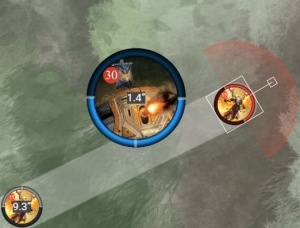
It cannot charge to the red position, even though the red position is within 2" of the target. Because the Archon has not kept the charge target in it's melee range.
There is a rule with charge movement that can be paraphrased as: Once your charge target is in your melee range, it cannot leave your melee range. This rule means you cannot charge past your charge target, then spin around to get them back in melee range.
It is particularly relevant for models that can move through their charge target (with abilities like Flight or Incorporeal) but can also come up with small models with large melee ranges "skimming past" larger targets.
See also the diagram.
"Fail-Charge"
A model cannot run after casting a spell or using their feat. This rule exists to prevent players slinging spells around, then sprinting backwards to safety; the intention is to force players to play their spellcasters more aggressively.
However a model can charge after casting a spell or using a feat. This is only applicable to models that can actually cast spells before charging (i.e. models with a FOCUS, FURY, or ESSENCE stat can cast spells "at any time"). It doesn't apply to models that use their Combat Action to cast spells (i.e. models with a Magic Ability).
Players figured out a way to 'exploit' the charge rules to let their caster move a little faster after casting spells. The 'exploit' is that you can declare a charge vs any enemy in your LOS, even if you blatantly don't have enough movement to reach them (for instance, it's Turn 1 and both armies are still in their deployment zones). Since they're so far away you move SPD+3" then they're not in melee range so you fail the charge.
This trick is useful on Turn 1, when most of your army is running but you want your caster to cast some buff spells; getting your caster to move SPD+3" means they won't fall too far behind the runners. This trick can be useful on other turns too.
Many new players feel like fail-charges are an exploit when they first hear about it, but it has been part of the game since 2003 and has never changed, so it's probably going to stay.
Note: This "cannot run/charge after using a spell/feat" rule ...
- does not apply if you have Combat Caster
- does not apply to "Mini-Feats" (the term Mini-Feat is not actually a game term).
- does not apply to non-spell "At Any Time" abilities (such as Battle Plans).
- when it comes to caster units (and/or Asphyxious4) there is a weird interaction with the "cannot run/charge after casting spells" rule and the Press Forward order's "Must run or charge" rule. This interaction is too complex to include in this basic training, but you can read about it here if you want to.
Assault attacks & Impact attacks
Assault attacks and Impact attacks are in cahoots with the charge rules. They are covered in the intermediate lessons:
- Assault: LPG - Shooting in melee
- Impact: LPG - Cavalry