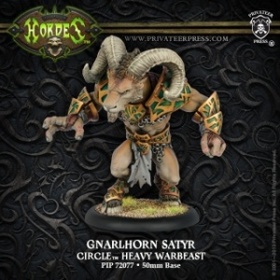
Gnarlhorn Satyr

From Warmachine University Archive
Jump to navigation Jump to search

Mk4 has been announced, and we need to talk about what it means for the future of this website.

Please join the discussion either on the WMU Facebook Group or the Talk:Main Page area of this wiki.

Circle Logo.jpg Gnarlhorn Satyr

Circle Heavy Warbeast

Satyrs are elusive beasts, protected for centuries by the druids of the Circle Orboros. Only recently have these loyal creatures been called upon to join battles abroad. Gnarlhorn satyrs are creatures of pure strength and unyielding force, capable of ramming foes with steel-buckling power. Shadowhorns possess a nimble athleticism which lets them perform impressive feats in battle, such as using an attacker’s own momentum against it. Rip horns are more cunning than their cousins but every bit as fierce, smashing into their enemies to break their lines and formations.

Basic Info

Gnarlhorn Satyr
Missing Info
Gnarlhorn Satyr.jpg
COST {{{cacost}}}
UNIT SIZE {{{casize}}}
FA {{{cafa}}}
Warcaster 0
BASE Large
SPD 5
STR 12
MAT 6
RAT N/A
M.A. N/A
DEF 12
ARM 18
CMD N/A
ESSENCE {{{essence}}}
FOCUS N/A
FURY 3
THRS 8
HP 26
F. Field N/A
WJP {{{wjp}}}
WBP {{{wbp}}}
IHP {{{ihp}}}
FA U
UNIT SIZE N/A
COST 10
N/A
N/A
N/A
Warcaster 1
COST N/A
N/A
Understanding
the Statblock

Abilities

  • Warbeast - All warbeasts share a huge stack of special rules. The short version is they're big, furious, and beat stuff up pretty good. Click here for a newbie-friendly recap, or click here for the full rules.
  • Pathfinder symbol.jpg Pathfinder
  • Counterslam - When an enemy model advances and ends its movement within 6" of this model and in its LOS, this model can immediately make a slam power attack against it. This model can use Counterslam only once per round and not while engaged.
  • Follow Up - When this model slams an enemy model, immediately after the slam is resolved this model can advance directly toward the slammed model, up to the distance the slammed model was moved.
  • Grand Slam - This model can make slam power attacks without spending focus or being forced. Models slammed by this model are moved an additional 2".

Weapons

Horns
Sword icon.jpg  RNG   POW   P+S 
1 4 16
  • Hard Head - This model can add this weapon's POW to its head-butt and slam power attack damage rolls.
Claw (x2)
Sword icon.jpg  RNG   POW   P+S 
1 3 15

Animus

COST RNG AOE POW DUR OFF
Earth's Blessing

1 SELF - - Round No
The spellcaster cannot be pushed, knocked down, made stationary, or moved by a slam. Earth's Blessing lasts for one round.

Theme Forces

Recent Changes

2021 10 Mega Update

  • -2 points

Thoughts on Gnarlhorn Satyr

Gnarlhorn Satyr in a nutshell

Counterslam. Follow Up. Grand Slam. Do you like slams? Slams done by really cheap heavy warbeasts? Because it is very good at slams. And is a cheap heavy warbeast (it's a little exaggeration to say it has one job).

Like all cheap heavy warbeasts its unbuffed performance is lackluster. This is because the balance point is that a heavy warbeast with a two fury buff (like Primal, Rage, or Scything Touch) is considered equivalent to a warjack that has been allocated two Focus. So unlike warjacks like the Nomad the range of warlocks that go well with the Gnarlhorn is sharply limited - but with three basic attacks and the ability to buy three more for twelve points that's a lot of work you can get out of any buffs you have despite its hardest hitting attack being P+S 16.

Combos & Synergies

As mentioned the Gnarlhorn is only really worthwhile when it is buffed.

  • Gorax Rager or Feral Warpwolf - it needs a damage buff if it's to do anything to heavies.
  • Tanith the Feral Song - the Gnarlhorn can counterslam, then admonition away, either back into control, or onward to engage other models. Alternatively if it gets charged, it can Admonition out of melee, and then Counterslam the model that charged it. Also the ability to give it Dark Shroud is an excellent damage buff.
  • Kromac, Champion of the Wurm - His feat buffs the slam damage
  • Kaya the Wildborne gives +2 to all melee attack rolls which includes slams, bringing it to effective MAT 8 (9 with Primal)
  • Kaya the Wildheart has Synergy. This is exactly the damage buff the Satyrs need.

Drawbacks & Downsides

  • By heavy standards the Gnarlhorn is extremely pillow-fisted. Low Fury for a heavy and very low damage means it requires buffs.
  • Slams tend to offer pretty predictable threat vectors
  • A good slam roll can take it out of control range
  • You will be able to use Counterslam usually only on very unaware opponents

Tricks & Tips

  • Remember that the Gnarlhorn is one of the cheapest heavies anywhere. Feel free to sacrifice it.
  • It's animus is really good on high def, low arm casters that are vulnerable to getting knocked down.
  • Look at whatever's behind the Gnarlhorn; you can slam models pretty far.


Other
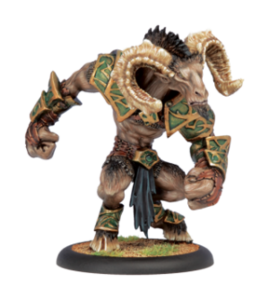
Classic sculpt

Trivia

  • Resculpted around 2013, now comes in a triple kit with the other two satyrs
  • Released in Hordes: Evolution (2007)

Other Circle models

Circle Logo.jpg       Circle Index       (Edit)
Battlegroup & Similar
Warlocks Baldur1 - Baldur2 - Bradigus1 - Grayle1 - Iona1 - Kaya1 - Kaya2 - Kaya3 - Kromac1 - Kromac2 - Krueger1 - Krueger2 - Mohsar1 - Morvahna1 - Morvahna2 - Tanith1 - Una2 - Wurmwood1
Lesser Warlocks

Krueger0 - Una1

Warlock Attachment

Druid Wilder - Tharn Blood Shaman

Light Argus Moonhound - Winter Argus - Wild Argus - Gorax Rager - Razorwing Griffon - Rotterhorn Griffon - Scarsfell Griffon - Wold Wight - Woldwatcher - Woldwyrd
Heavy Gnarlhorn Satyr - Riphorn Satyr - Shadowhorn Satyr - Feral Warpwolf - Pureblood Warpwolf - Warpwolf Stalker - Wold Guardian - Woldwarden
Brennos the Elderhorn (Satyr) - Ghetorix (Warpwolf) - Loki (Warpwolf) - Megalith (Woldwarden)
Gargantuans Storm Raptor - Woldwrath
Units, Solos, Battle Engines, & Structures
Units Druid Mist Riders - Druids of Orboros & CA - Reeves of Orboros & CA - Sentry Stone & Mannikins - Shifting Stones & CA - Stoneward & Woldstalkers - Tharn Bloodtrackers & Character UA - Tharn Bloodweavers & CA - Tharn Blood Pack - Tharn Ravagers & CA - Tharn Wolf Riders - Warpborn Skinwalkers & CA - Wolves of Orboros & CA
Brighid & Caul - Death Wolves
Solos

Blackclad Stoneshaper - Blackclad Wayfarer - Bloodweaver Night Witch - Chuck Dogwood - Druid Wilder - Gallows Grove - Kogan the Exile - Krueger0 - Lord of the Feast - Reeve Hunter - Primal Archon - Shivers - Tharn Blood Shaman - Tharn Ravager Shaman - Tharn Ravager White Mane - Tharn Wolf Rider Champion - Una1 - War Wolf - Wolf Lord Morraig

Battle Engines & Structures Celestial Fulcrum (Engine) - Well of Orboros (Structure)
Theme Forces
Secret Masters - The Bones of Orboros - The Devourer's Host - The Wild Hunt
Minions
Refer to Who Works for Whom and/or Category: Circle Orboros Minion
This index was last updated: 2021.10

Rules Clarifications

RC symbol.png

Rules Clarification : Hard Head      (Edit)

  • You can add the POW even if the weapon system is crippled.
  • Hard Head doesn't get applied to collateral damage, because that is a separate type of roll. Refer page 45 of the mini rulebook.
RC symbol.png

Rules Clarification : Open Fist  (aka, Power Attack Throw)     (Edit)

  • Throw ( Edit )
    • See also the Throw article for a recap of the core Throw rules.
    • If a model is somehow thrown at itself (which can happen with Durst1's feat) it would not move, it would be knocked down, and it would take a standard power attack damage roll but it would not take an additional die for colliding with itself. (Infernal Ruling)
    • Because you move the target model between the attack roll and the damage roll, you can get different buffs applied to the two rolls. For instance, if you throw the target in or out of a Flanking model's melee range.
  • Incorporeal vs Slammed/Thrown models ( Edit )
    • Incorporeal models cannot be moved by someone trying to slam them.
    • Slammed models can move through Incorporeal models.
      • If they have enough movement to get past them, no dramas.
      • If they land on them, you move the Incorporeal model out of the way as per the Rule of Least Disturbance.
      • If the Incorporeal model cannot be moved (i.e. it's a flag) then you move the slammed model out of the way, also by the rule of Least Disturbance.
      • For the purposes of Collateral Damage, only the model(s) you contacted before you applied the rule of Least Disturbance count as contacted.
    • The same logic applies to Throws.
  • Collateral Damage
    • Collateral damage cannot be boosted and is not considered damage from an attack or model. Refer page 33 of the 2021.08 version of the rules pdf. As a result:
      • It doesn't trigger stuff that relies on being hit by an enemy (such as Shock Field) or damaged by an enemy (such as Vengeance).
      • It doesn't get bonus damage from stuff that adds to a model's damage roll (such as Signs & Portents or Prey).
      • It doesn't matter if the attacker has crippled weapon systems or aspects.
  • Throw - Power Attack
    • When you make a Throw Power Attack, no other abilities of the Fist weapon (such as Chain Strike) are applied unless they specifically mention Throws. (Locked Thread)
    • If you do a Power Attack Throw and you choose to throw the target directly away, no deviation is rolled to determine the final position of the model. (Locked thread)
    • A model that cannot be targeted by melee attacks (such as Una2's feat) cannot have models thrown at them, either. (Infernal Ruling)
    • Since throwing Model [A] at Model [B] involves making a melee attack roll vs Model [B] which is out of your melee range, it technically breaks a whole bunch of core rules. (Infernal Checking)
    • Even though you make a "melee attack roll" vs Model [B] you don't actually make a melee attack vs it. Also, the damage it suffers is from Collateral damage, not from the original attack. So you can't trigger stuff like Snacking from damage you did to Model B.


RC symbol.png

Rules Clarification:  : Warbeast      (Edit)
(Click Expand to read)

See also the Warbeast page for a recap of the core warbeast rules.
  • Forcing
    • If an ability doesn't specify how much it costs to force, it costs 1. (Infernal Ruling)
  • Animi
    • A single Animus can be on several models at the same time. (Infernal Ruling)
    • Unlike in Mk2, in Mk3 if a model has an animus on it from any source and then another animus is cast on that model, it will lose the first instance of an animus and will be replaced by the second. It does not matter if either the first animus or the second animus is from a warlock or warbeast. (Infernal Ruling)
    • An animi cast by a warlock is an animi and a spell. (Infernal Ruling)
  • Transferring Damage
    • If both the warlock and the warbeast are damaged by the same attack (such as an AOE), then you need to apply the 'normal' damage to the warbeast before the transferred damage. This distinction can be important when you're working out who/what actually destroyed the beast. (Infernal Ruling)
  • Frenzy (Edit)
    • You cannot trigger optional abilities (such as Cleave or Sprint). (Infernal Ruling)
    • You must trigger compulsory abilities (such as Consume) ... except for compulsory abilities that also generate an extra attack (such as Berserk). In that case, you don't get the Berserk attack. (Infernal Ruling)
    • A warbeast may not make an Assault shot as part of a Frenzy activation.
    • If the closest target to a warbeast resolving a Frenzy cannot be charged, then the warbeast will forfeit movement and action (as per the rules of having to charge and not being able to). (Infernal Ruling)
    • If a frenzying warbeast can't reach its charge target (because the charge lane is blocked by terrain, etc) then it will make a failed charge and end its activation. (Locked thread)
    • If a frenzying warbeast has two melee weapons with the same POW, it can choose which one to use. (Infernal Ruling)
RC symbol.png

Rules Clarification : Pathfinder      (Edit)

RC symbol.png

Rules Clarification : Counterslam      (Edit)

  • This ability suffers all the complications that Countercharge and Slam have ... combined.
RC symbol.png

Rules Clarification:  : Slam      (Edit)
(Click Expand to read)

 
  • General
    • If you slam someone via a Power Attack the distance they move depends on relative base sizes.
    If you slam someone via a weapon or spell, the distance they move will be as per that weapon's/spell's rules text. Sometimes it doesn't depend on base size.
    • Obstacles stop slams, but they don't stop throws.
    Obstructions stop both.
    • If three models are B2B and in a triangle formation, and you slam one toward the other two, it will contact both those two models simultaneously. (Infernal Ruling)
    • You can add model special rules (such as Gang) to the damage roll.
  • Power Attack Slam
    • You don't add any special rules on your model, unless it specifically refers to Power Attack Slam (such as Hard Head)
    • You can use an "any time" ability after resolving the slam movement but before the slam attack roll. (Infernal Ruling)
    • The range of a Power Attack Slam is irrespective of your weapon range:
      • A Power Attack Slam made by a colossal or gargantuan has a 2˝ melee range.
      • A Power Attack Slam made by any other model has a 0.5˝ melee range.
    • You can boost the damage roll.
  • Weapon Slam (ie Smite)
    • You use the weapon's full P+S, not the attacker's base STR.
    • You can add weapon special rules (such as Weapon Master) to the damage roll.
    • You can boost the damage roll (and if you charged, it is auto-boosted).
  • Dual Attack & Slam/Trample ( Edit )
Power Attack Slam and Trample combine your Normal Movement and Combat Action, and how this works with Dual Attack is:
  • Slam: You must resolve the movement, the attack, and moving the slammed model. Only then can you make initial ranged attacks.
  • Trample: You must resolve the movement, the attacks, and the free strikes. Only then can you make initial ranged attacks.
  • (Infernal Ruling)
  • Incorporeal vs Slammed/Thrown models ( Edit )
    • Incorporeal models cannot be moved by someone trying to slam them.
    • Slammed models can move through Incorporeal models.
      • If they have enough movement to get past them, no dramas.
      • If they land on them, you move the Incorporeal model out of the way as per the Rule of Least Disturbance.
      • If the Incorporeal model cannot be moved (i.e. it's a flag) then you move the slammed model out of the way, also by the rule of Least Disturbance.
      • For the purposes of Collateral Damage, only the model(s) you contacted before you applied the rule of Least Disturbance count as contacted.
    • The same logic applies to Throws.
  • Collateral Damage
    • Collateral damage cannot be boosted and is not considered damage from an attack or model. Refer page 33 of the 2021.08 version of the rules pdf. As a result:
      • It doesn't trigger stuff that relies on being hit by an enemy (such as Shock Field) or damaged by an enemy (such as Vengeance).
      • It doesn't get bonus damage from stuff that adds to a model's damage roll (such as Signs & Portents or Prey).
      • It doesn't matter if the attacker has crippled weapon systems or aspects.
  • Counterslam - Refer to the Countercharge clarification, below, but mentally swap the word "Countercharge" for "Counterslam".
RC symbol.png

Rules Clarification:  : Countercharge      (Edit)
(Click Expand to read)

    Timing    
  • If the moving model has Assault, the Countercharge is resolved before the Assault attack. (Infernal Ruling).
  • If the moving model has a rule that resolves "at the end of Normal Movement" (such as Slipstream), the Countercharge is resolved before the other rule. (Infernal Ruling)
  • The moving model cannot use an "Any Time" after finishing their advance but before your Countercharge. They can use it only after the Countercharge is resolved.
  • If the non-countercharging player has a similar "ends an advance" trigger (such as Admonition) then they can trigger and resolve that from your countercharge movement.
    • Example: Model [A] charges, and triggers Countercharge on [B]. Model [B] countercharges, and triggers Admonition on [C].
      Resolve Admonition on [C]. Then finish resolving Countercharge on [B]. Then finish model [A]'s activation.

    Triggering Countercharge    

  • You can trigger Countercharge if you're engaging, but not engaged.
  • You can trigger Countercharge during your own turn, if your opponent has an ability to move during your turn (such as Admonition).
  • Some abilities let you "ignore intervening models when declaring a charge" (such as Flight). Unfortunately, you still need LOS to trigger Countercharge, and it's only after CC is triggered that you actually get to declare a charge. In other words, Flight and Countercharge don't work together for LOS purposes.
  • What does trigger Countercharge
    • Countercharge triggers off any advance, not just in-activation stuff.
    • Standing still but changing facing is an advance.
  • What doesn't trigger Countercharge
    • Aiming, or forfeiting your movement, is not advancing.
    • If a model doesn't move, doesn't change facing, doesn't aim ... does nothing but skips straight ahead to its Combat Action, this is not an advance. (Infernal Ruling)
    • Being placed (such as Teleport) is not an advance.
    • Involuntary movement (being slammed, thrown, or pushed) is not an advance.
  • When a unit is moving, countercharge is triggered on a model-by-model basis. So you can countercharge after any model in the unit has finished its move within range, but you can only countercharge that model who just finished its movement. You can't "save it" until the entire unit finishes moving and then say "I'm going to Countercharge the first guy you moved."

    Attacks, Boosting, & Other Triggers    

  • You only get one attack when making a countercharge, regardless of how many initials you normally have.
  • The charge attack damage is only boosted if the Countercharger moved 3" or more, as with a regular charge.
  • Countercharge occurs outside of activation so you can't spend fury/focus to boost a countercharge attack, nor buy additional attacks afterwards, not trigger stuff that only happens during your Combat Action (like Berserk).
  • Even if you trigger Countercharge during your own activation, for the duration of you resolving the CC it "no longer counts" as being in your activation. (Infernal Ruling)

    After the Countercharge    

  • The countercharging model cannot use any abilities that trigger on "during activation" or "during combat action" (such as Sprint), as Counter Charge is not an activation. (Locked thread)

    Other interactions    

  • Countercharge during your own activation (Countercharge vs Admonition etc) ( Edit )
    • You can trigger Countercharge during your own activation, but only if an enemy model moves during your activation. For instance, you move towards a model who has Admonition and they trigger that to try to move away. (You do a normal move, they trigger admonition and move, you trigger countercharge from their admonition-move.)
    • However countercharge always counts as being out-of-activation, no matter when you trigger it. (Infernal Ruling)
    As a result, you can't trigger only-during-activation effects (such as Critical Shred & Sustained Attack).
    • On the other hand, you can potentially get two charge attacks (one for your normal charge, one for the counter charge). (Infernal Ruling)
      This ruling still applies even after the 2018.07 update (Infernal Re-ruling)
  • Countercharge plus Admonition
    • If a model has both CC and Admonition, it can trigger both at the same time. A model moves nearby, it admonitions away, then countercharges back in.
  • Countercharge Inception
    • If a model [A] has Countercharge, and it charges an enemy model [B] that has Countercharge and Admonition, then ...
      • Model [A] charges and triggers CC and Admo on [B]
      • Model [B] Admo moves but before it can resolve its own CC, it triggers CC on [A]
      • You now have two models that have triggered CC simultaneously. So the Active player gets to resolve their one first.
  • Assault vs Countercharge ( Edit )
  • Countercharge & Cavalry ( Edit )
    • A model with Countercharge and Cavalry can make Impact Attacks during the countercharge. (Refer "Charges Outside of Activation" in the rulebook).
RC symbol.png

Rules Clarification : Follow Up      (Edit)

  • If the target is killed by the slam damage, Follow Up cannot trigger because there is no model left on the table for you to move towards. (Infernal Ruling)
  • If you slam your target through smaller-based models, then you can only advance as far as those models - you can't walk through them.
  • You can use Follow Up on any kind of slam, not just on a Power Attack Slam.
  • You can use Follow Up on a slam caused by a ranged weapon. (Infernal Ruling)
RC symbol.png

Rules Clarification:  : Slam      (Edit)
(Click Expand to read)

 
  • General
    • If you slam someone via a Power Attack the distance they move depends on relative base sizes.
    If you slam someone via a weapon or spell, the distance they move will be as per that weapon's/spell's rules text. Sometimes it doesn't depend on base size.
    • Obstacles stop slams, but they don't stop throws.
    Obstructions stop both.
    • If three models are B2B and in a triangle formation, and you slam one toward the other two, it will contact both those two models simultaneously. (Infernal Ruling)
    • You can add model special rules (such as Gang) to the damage roll.
  • Power Attack Slam
    • You don't add any special rules on your model, unless it specifically refers to Power Attack Slam (such as Hard Head)
    • You can use an "any time" ability after resolving the slam movement but before the slam attack roll. (Infernal Ruling)
    • The range of a Power Attack Slam is irrespective of your weapon range:
      • A Power Attack Slam made by a colossal or gargantuan has a 2˝ melee range.
      • A Power Attack Slam made by any other model has a 0.5˝ melee range.
    • You can boost the damage roll.
  • Weapon Slam (ie Smite)
    • You use the weapon's full P+S, not the attacker's base STR.
    • You can add weapon special rules (such as Weapon Master) to the damage roll.
    • You can boost the damage roll (and if you charged, it is auto-boosted).
  • Dual Attack & Slam/Trample ( Edit )
Power Attack Slam and Trample combine your Normal Movement and Combat Action, and how this works with Dual Attack is:
  • Slam: You must resolve the movement, the attack, and moving the slammed model. Only then can you make initial ranged attacks.
  • Trample: You must resolve the movement, the attacks, and the free strikes. Only then can you make initial ranged attacks.
  • (Infernal Ruling)
  • Incorporeal vs Slammed/Thrown models ( Edit )
    • Incorporeal models cannot be moved by someone trying to slam them.
    • Slammed models can move through Incorporeal models.
      • If they have enough movement to get past them, no dramas.
      • If they land on them, you move the Incorporeal model out of the way as per the Rule of Least Disturbance.
      • If the Incorporeal model cannot be moved (i.e. it's a flag) then you move the slammed model out of the way, also by the rule of Least Disturbance.
      • For the purposes of Collateral Damage, only the model(s) you contacted before you applied the rule of Least Disturbance count as contacted.
    • The same logic applies to Throws.
  • Collateral Damage
    • Collateral damage cannot be boosted and is not considered damage from an attack or model. Refer page 33 of the 2021.08 version of the rules pdf. As a result:
      • It doesn't trigger stuff that relies on being hit by an enemy (such as Shock Field) or damaged by an enemy (such as Vengeance).
      • It doesn't get bonus damage from stuff that adds to a model's damage roll (such as Signs & Portents or Prey).
      • It doesn't matter if the attacker has crippled weapon systems or aspects.

Rules Clarification : Grand Slam - None yet. (Edit)

Rules Clarification : Earth's Blessing - None yet. (Edit)