101 - Warlocks
| 101 Articles (Edit) |
|---|
| Models
Gameplay Attacks & Actions
Battlegroup
Other |
| LPG Articles (Intermediate) |
| LOTS Articles (Advanced) |
- This article is part of Warmachine University's Crash Course (101) series, which is "Basic Training" aimed at new players who are still learning the core rules.
- The 101 series is intended to help you understand the rulebook, but you shouldn't be reading this instead of the rulebook.
This article is a recap of the Warlock rules. (For a verbatim copy of the rules, refer to Warlock.) If you've just read the 101 article on Warcasters, you'll find this article is very similar; the only real differences are animus spells, how warlocks get fury, and how warlocks reduce damage.
More unususal caster types, such as Infernal Masters, are covered in the Intermediate LPG series.
- Note: Most players use the word caster as shorthand for warcaster and/or warlock and/or Infernal Master.
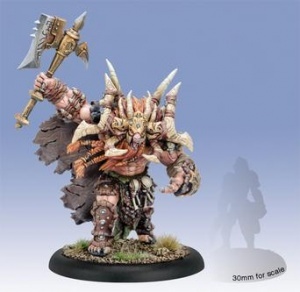
If Hordes was chess, then Warlocks would be a King piece and a Queen piece combined. They are extremely powerful (like a Queen piece) but if they die then you instantly lose the game (like a King piece). They are very skilled combatants, leaders, and spellcasters in and of themselves - but their true potential is unlocked when they lead a battlegroup of warbeasts.
Warlocks have access to fury, a supply of magical energy, and they can use this fury to either:
- Cast spells - Perhaps the primary purpose of fury is to fuel the spells you cast. Different casters have different spells available that can be offensive, self-buffing, army-buffing, and/or enemy de-buffing. This "spell list" shapes the caster's playstyle, strategy, and the types of models they like to put in their army.
- Boost attacks - Casters can spend a single fury to add one die to any attack roll or damage roll the caster makes. Each boost must be bought separately, and each roll can only be boosted once.
- Buy attacks - Casters can spend fury to make extra attacks. Most ranged weapons cannot make extra attacks, but all melee weapons can make an unlimited number of attacks.
- Transfer damage - Casters can choose to not spend their fury, and instead use it during the enemy turn to redirect the damage your opponent inflicts on your caster. This is called camping your fury.
- Heal battlegroup - Warlocks can heal themselves or their warbeasts.
You will never have enough fury to do all the things you want to do in a single turn - the game is designed such that you are resouce-starved and so you need to make meaningful choices about what you spend fury on.

|
Tip !
|
Name and Number
You will see casters with a number beside their name, such as Caine1 and Caine2. These refer to the same character at different points in the overall storyline. They are different physical models and they'll have slightly different abilities and spells but have the same "feel" to them.
You cannot use multiple versions of the same character in the same army - for instance you cannot have Caine1 fight alongside Caine2. Each player can, however, have the same characters - you can have Caine1 fight against Caine1 if you really wanted.
A model with a number is always a character model. This is relevant for a few special rules like Fortune Hunter.
Feat
Every caster in the game has a once-per-game ability called a Feat which, if used smartly, can really turn the tide of battle in your favour. Every feat is unique (barring one exception: Sturgis1 and Sturgis2).
Control Range
A caster's control range is equal to double its current FURY statistic, not its current unspent fury points. In other words, your control range does not shrink as you spend fury.
A control range is used to determine which warbeasts can be forced for fury, which makes them much more powerful. Also, many spells and feats will work on all models in your control range.
Fury
How fury is generated & leeched
- Warlocks do not auto-replenish fury (warcasters do). Instead warbeasts generate the fury, and next turn the warlock harvests it. The steps are:
- How warbeasts generate fury is covered in the warbeast section below. Essentially anything that a warjack would spend a focus to achieve, a warbeast instead generates a fury to do the same thing.
- At the start of each turn, fury left over from last turn does not expire.
- The warlock leeches fury from their warbeasts that are in their control range. You move the fury points from the warbeasts to the warlock, up to the warlock's current FURY stat.
- If there is still any fury on any warbeasts (ie your warlock wasn't able to take it all) then you have to check whether that warbeast will frenzy this turn instead of acting normally.
Tip: You don't want your beasts to frenzy. - If your warlock has less fury points than their current FURY stat (ie your beasts weren't furious enough to fill you back up), and if any of that warlock's warbeasts have died in a previous turn, then the warlock can spirit bond the dead warbeast(s) and gain 1 fury point per dead warbeast, up to their FURY.
- If, after spirit bond, your warlock still has less fury points than their current FURY stat then the warlock has the option of leeching their own lifeforce for more fury points; they can gain one fury point per damage point they put on themselves.
- Also, if a warbeast dies to an enemy attack or continuous effect (Fire & Corrosion) while in the warlock's control range, the warlock can reave that warbeast's fury.
- The warlock has to take all the fury currently on that warbeast, up to the warlock's current FURY stat.
- You cannot reave from warbeasts that you kill with friendly models.
- You cannot reave from warbeasts that you kill with transferred damage (see below).
Casting spells
- Each spell has a COST, and you have to spend that many fury points to cast it. After that, it's a matter of finding a target in range and, if it targets an enemy model, rolling to hit/damage them. You will never have enough fury to cast all your spells.
- Upkeep spells: Once they're in play, you only need to spend one fury next turn to keep them in play next turn (rather than the full COST). On the other hand, you can only have one copy of an upkeep in play at once - if you cast it on a new target, the earlier version immediately expires.
- Target: SELF spells: Some casters can put a buff on themselves. Sometimes this is purely a self-buff (like Engine of Destruction) but othertimes it affects everyone in their control range or command range (like Fog of War).
- Channeling spells: Some armies have access to non-warlock models with the Channeler advantage. This is much rarer for Warlocks than it is for Warcasters. Channelers allows the warcaster to cast spells "through" that model. Basically, after paying the COST of the spell, you can target any model that is in range of the channeler model (rather than just targets in range of the warcaster model).
- The channeler needs to be in your control range, but you don't need LOS to it.
- The channeler needs to be not engaged by an enemy model (but it can be engaging an enemy model).
- The channeler needs LOS to the target, you can't cast spells on stuff behind the channeler.
Animus spells
- Warbeasts have dormant arcane spells that warlocks can unlock. The warbeast can cast their own animus during their activation. Also, a warlock can cast any animus from any of their own warbeasts as if it were a spell on their own spell card (as long as that warbeast is in their control range).
- This allows you to tailor your warlock's spellcasting ability at the army-list building stage, because you can choose warbeasts based not just on their prowess but also on how useful their animi is to the warlock.
Buying/Boosting attacks
- Warlocks can ramp up their prowess and become true monsters by spending fury on attacks. This does, however, leave you with less fury to cast spells, or defend against enemy attacks.
- Warlocks can spend 1 fury to buy one melee attack.
- This is a basic attack, with one of their melee weapons.
- You can continue buying more attacks as long as you have the fury to afford it.
- Warlocks can spend 1 fury to buy one melee attack.
- Warlocks can spend 1 fury to boost any attack roll or damage roll (ranged, melee, and/or spells).
- Each roll is paid for seperately.
- Each roll can be boosted only once.
- You can continue boosting different rolls as long as you have the fury to afford it.
- Warlocks can spend 1 fury to boost any attack roll or damage roll (ranged, melee, and/or spells).
- Some warlocks can spend focus to buy ranged attacks, but they need a special rule to do so.
Transfer Damage & Heal Damage
- When a warlock suffers damage from any source, it can transfer that damage to one of their warbeasts.
- The warlock spends 1 fury point each time it does this.
- The warbeast needs to be in the warlock's control range.
- You can't transfer to a warbeast that is already at max fury.
- If the transfer damage kills the warbeast, then you cannot reave fury from that warbeast. Also, if the damage exceeds the warbeast's hitpoints, any leftover damage must be applied to the warlock - you can't transfer it a second time.
- Whether or not there was leftover damage, the warlock counts as being damaged (for the purposes of stuff like Drag, Vengeance, etc).
- Also, warlocks can spend fury during their activation to heal damage on themselves or on their warbeasts that are in their control range. You heal 1 hitpoint per fury spent.
Interaction with Warbeasts
Interaction
Placeholder
Battlegroup
When you build your army list you assign warbeasts to be in your warlock's battlegroup. In fact, you have to assign a minimum number to each battlegroup. A caster can only leech fury from their warbeasts, gain animi from their warbeasts, and many spells/feats only affect battlegroup models (such as Energizer).
A battlegroup is a shared noun, a bit like the word "team"; the warbeasts are in the warlock's battlegroup, but also the warlock is in the warbeast's battlegroup.
It is possible to add more warjacks to your battlegroup mid-game, but only if that warjack's original controller died earlier in the game. This doesn't happen very often, especially in beginner games, so we won't cover it here. Instead it is detailed in the intermediate lesson LPG - Death of a Controller.
WBP
Each warlock has a stat called WBP. These are bonus army points that must be spent on warbeasts and those warbeasts must be assigned to that warlock's battlegroup. This forces you to play with a minimum number of warjacks in the game.
Lesser Warlocks do not get WBP.
Warlocks - Model Type
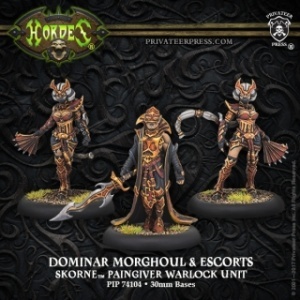
Most warlocks are a simple warrior model. But sometimes casters have extra/different types, which complicates their "normal caster functions" as follows:
Warlock Cavalry
Cavalry can make impact attacks, which allows the cavalry model to "pause" their movement mid-charge. Caster cavalry are not allowed to cast spells or trigger their feat during this "pause".
Warlock Unit
There's a weird interaction between a unit getting a Press Forward order (which means models must run or charge), a warlock casting a spell or using a feat (which means they can't run), and what happens if the warlock in a unit doesn't have LOS to a legal charge target. What if casting a spell changes the LOS? What if moving one of the other troopers changes the LOS?
This has had Infernal Rulings, clarifications on the ruling, updated rulings, and clarifications on updates. As of 2020.08 I've given up making sense of it, so instead here's a link to the 7th August 2020 ruling.
Warlock Battle Engine
There is no specific interaction between the battle engine rules and the caster rules.
Companions
Some casters come with a Companion model, normally a solo but sometimes a warjack or warbeast. These Companions are completely separate models, with their own activation, and don't interfere with the normal caster rules at all. Essentially, they're just a free bonus model when you take that caster.
Warlock Destruction
Normally when your main caster dies you lose the game, so "what happens next" doesn't come up that often. But those same rules kick in when a Lesser Warlock dies. See LPG - Death of a Controller for the Wild warbeast rules and how to re-tame them.
Warlock-adjacent models
Warlock attachment
Certain models serve as a Warlock Attachment. These models normally buff the caster's arcane power in some fashion or another, and follow their warlock around the entire game giving that buff each turn.
A few notes:
- A warlock attachment must be attached to a warlock - you can't add it to your army "by itself".
- Each warlock can only have one warlock attachment.
- An attachment is not part of your battlegroup. It won't gain benefits from certain spells, feats, etc.
- Sometimes an attachment has a separate rule, Companion, which does make it part of the battlegroup.
- An attachment has a separate activation to the warlock.
Lesser Warlocks
This is a special rule that shows up on a few solos, units, and battle engines. It gives that model all the same rules as a warlock except 1) they don't get a feat, and 2) if/when they die you don't auto-lose the game.
Just a couple of things to keep in mind:
- A Lesser Warlock's battlegroup is completely different to your main warlock's battlegroup.
- They can't swap warbeasts mid-game.
- They can't take fury from, transfer damage to, or cast animi from each other's warbeasts.
- They can't cast spells that specify "target battlegroup warbeast gains XXX" on each other,
- etc
- When a Lesser Warlock dies, it traumatizes their warbeasts and those 'beasts go wild.
- While wild a warbeast can't do anything ... but other warlocks can manually re-tame the warbeast.
- We cover this in the intermediate article LPG - Death of a Controller.
Other
Rules Clarifications

|
Rules Clarification: : Warlock (Edit) | ||||
|